AI Prompt Engineering Best Practices 2026


 0 (0 reviews)

Prompt engineering is no longer a “clever trick” used by early adopters. By 2026, it has quietly become one of the most practical control layers businesses have over large language models in production. It has already reached the mark of slightly over $222 in 2023, and keeps growing tremendously.
Recent industry surveys show that over 70% of companies using LLMs in live systems rely on prompt-level logic rather than fine-tuned models for their core workflows. The reason is simple: most business problems don’t fail because the model is weak — they fail because instructions are vague, inconsistent, or impossible to enforce at scale. Artjoker will reveal prompt engineering best practices 2026 based on its own cases.
What Is Prompt Engineering and Why It Matters in 2026?

Before we move to the agentic AI prompt engineering best practices, here is how companies benefit from it. In real systems, the pain points show up fast:
- Outputs vary between runs, even for the same task
- Small prompt changes break downstream automation
- Business rules live in documentation instead of code
- Engineers spend more time “debugging prompts” than building features
- Stakeholders lose trust because the system feels unpredictable
In 2026, the best practices for prompt engineering in AI matter more than ever because LLMs are no longer used in isolation. When a model output triggers an action — creates a ticket, flags a transaction, sends a message, or updates a record — ambiguity becomes expensive. To minimize costs and maximize efficiency, we suggest that you make use of the professional OpenAI development.
Designing AI Systems That Behave Consistently is Hard?
Artjoker supports teams with prompt architectures, evaluation pipelines, and fine-tuning strategies that are testable and safe to operate at scale. Hire prompt engineers!
Check our talent pool of 100+Problems It Can Solve
Without ChatGPT prompt engineering best practices, poorly designed prompts introduce certain risks:
- Silent errors that pass validation but break workflows
- “Confidently wrong” outputs that look correct to non-experts
- Escalation overload when edge cases aren’t bounded
- Compliance issues when instructions drift over time
Prompt engineering matters because it is the fastest, cheapest, and most controllable way to align powerful general-purpose models with messy real-world business logic — without pretending those models are deterministic systems.
How Prompting Works Across Modern LLMs?
Most production LLM calls are not a single prompt — they’re a prompted program with structured inputs and strict outputs. What changes across models is how they react to the same program:
- Instruction hierarchy differs. Some models heavily prioritize system messages; others blend roles more loosely. If your app depends on hard constraints (format, refusal behavior, tool usage), you need model-specific tests.
- Context packing is part of the prompt. Retrieval snippets, conversation state, user profile, and policy text compete for attention. The ordering, chunking, and redundancy you choose can shift results as much as the wording.
- Tool use is prompt-defined. If you want deterministic actions, you don’t “ask nicely.” You expose tools (functions) with typed signatures, specify when they must be called, and validate the tool outputs before generating final text.
- Output shape is an interface contract. In production, a “good answer” is often invalid if it breaks JSON, misses fields, or invents IDs. Prompting works best when you treat output as a schema + validator, not prose.
- Sampling settings are part of behavior. Temperature/top-p aren’t aesthetic knobs; they’re stability knobs. If you need repeatability, you constrain decoding and push creativity out of the critical path.
The key idea: prompting isn’t “prompt text.” It’s system design at the boundary between probabilistic generation and deterministic software.
Why Prompt Engineering Became a Core Skill for AI Projects?
The best practices of prompt engineering sit exactly where most AI projects bleed:
- It’s the fastest control surface. You can iterate prompts, schemas, tool policies, and retrieval layouts without retraining, and you can ship fixes on the same cadence as product changes.
- It’s where reliability is won. Hallucinations are rarely solved by “better wording” alone — they’re reduced by adding constraints: tool-first flows, grounded retrieval, explicit refusal rules, and output validation.
- It’s where you make systems testable. A prompt that can’t be evaluated is a liability. Teams that treat prompts like code (versioning, unit tests, regression suites, golden datasets) can measure drift and prevent silent degradation.
- It’s where costs are governed. As inference becomes cheaper and more accessible, the temptation is to over-call models. Prompt engineering is how you minimize tokens, reduce retries, and route easy cases to smaller/cheaper paths.
- It’s where cross-functional alignment happens. Product defines intent; legal defines constraints; engineering defines interfaces. The prompt is often the only place these requirements meet in one executable artifact.
Deciding Between Prompt Engineering & Fine-Tuning?
Artjoker’s prompt engineering services help teams evaluate real workloads, error patterns, and scaling risks to choose the simplest strategy that works in production.
Get in touch with us to benefitFundamental Best Practices for Prompt Engineering in Large Language Models
Once LLMs move from experimentation into production, prompt quality stops being subjective. You’re no longer optimizing for “nice answers,” but for repeatability, traceability, and failure containment. The best practices for prompt engineering in large language models below come from what tends to hold up under real usage, not from toy examples.

Clear, Structured, Context-Rich Instructions
LLMs don’t fail because they “don’t understand English.” They fail because the task definition is underspecified. A strong prompt behaves more like a function signature than a paragraph of text. It clearly separates:
- What the model must do
- What inputs it receives
- What it must not do
- What success looks like
Context should be intentional, not maximal. Dumping everything you have into the prompt often degrades performance, because irrelevant details compete with signals.
Specify Format, Tone, Constraints, Output Style
In production systems, output is an interface, not prose. Good prompts define:
- Exact output format (JSON schema, table, enum, bullet list).
- Allowed values and edge-case behavior.
- Tone and verbosity boundaries (concise vs explanatory, neutral vs empathetic).
- Refusal and fallback rules when information is missing or ambiguous.
This is not about politeness — it’s about preventing downstream breakage. A response that is “correct” but unparseable is functionally wrong.
Iteration: Test, Refine, Improve
Prompting is not a one-shot activity. It’s an engineering loop. Teams that succeed treat prompts as versioned artifacts and test them against:
- Known-good examples,
- Known-bad edge cases,
- Real historical inputs.
Small wording changes can shift behavior in non-obvious ways, so changes should be isolated, measured, and reversible. Importantly, iteration should focus less on improving “average quality” and more on reducing failure modes. In real systems, the worst 5% of outputs often cause 80% of operational pain.
Use Examples (Few-Shot) for Better Accuracy
When rules are hard to express but patterns are consistent, examples outperform explanations. Few-shot prompting works best when:
- Examples are representative, not idealized
- Edge cases are included intentionally
- Labels or outcomes are unambiguous
The goal isn’t to teach the model everything — it’s to anchor behavior.
Advanced Prompt Engineering Techniques in 2026
As LLMs moved deeper into production systems, prompt engineering evolved beyond “better wording.” In 2026, advanced prompting is mostly about controlling behavior under uncertainty, reducing variance, and making model outputs operationally safe. The techniques below are used when simple instruction tuning is no longer enough.

Decomposition: Breaking One Task into Deterministic Subtasks
A reliable pattern is explicit task decomposition:
- Step 1: classify or route the input
- Step 2: apply logic or extraction
- Step 3: generate the final output
This is especially effective in workflows like document processing, support triage, compliance checks, and QA scoring.
Constraint-Driven Prompting (Rules Before Reasoning)
One of the biggest shifts in recent years is prioritizing constraints over creativity. Instead of asking “figure out the best answer”, advanced prompts:
- Define hard rules first
- Limit allowed actions or outputs
- Allow reasoning within those boundaries
This technique doesn’t make the model “smarter,” but it makes it safer and more predictable, which matters far more in production systems than elegance.
Self-Verification and Output Validation Prompts
Modern prompts increasingly include a verification step, either explicitly or implicitly. Instead of trusting the first output, the model is asked to:
- Check its own result against rules
- Validate format and completeness
- Flag uncertainty when confidence is low
This is not about philosophical self-reflection. It’s a practical way to catch missing fields, contradictory statements, and unsupported conclusions.
Prompt Versioning and Environment-Aware Prompts
By 2026, prompts are no longer static text blobs. They are versioned, tested, and environment-aware artifacts. Advanced teams:
- Keep prompts in source control
- Track changes alongside metrics
- Adjust behavior based on environment (test vs production, region, language, risk level)
This turns prompting into a managed system rather than an ad-hoc activity — and makes large-scale AI deployments maintainable over time.
Prompt Engineering Frameworks That Always Work
Most prompt failures don’t come from model limitations. They come from missing structures.

C.O.S.T. Framework (Context — Objective — Steps — Tone)
The C.O.S.T. framework is effective because it mirrors how humans receive instructions in real work environments.
- Context sets the operating environment. It answers where and under what conditions the task exists.
- Objective defines success in one clear sentence.
- Steps break the task into ordered actions.
- Tone controls style, risk tolerance, and communication level, which is especially important for user-facing outputs.
This framework works well for operational workflows, internal documentation, support and QA automation, and analytical summaries where clarity matters more than creativity. Its main strength is predictability.
R.A.G.E. Framework (Role — Action — Guidelines — Examples)
R.A.G.E. is most useful when output quality depends on perspective and judgment, not just correctness.
- Role anchors the model in a specific expertise level or responsibility.
- Action defines what must be produced, not how clever it should be.
- Guidelines introduce constraints, exclusions, and priorities.
- Examples remove ambiguity by showing acceptable outcomes rather than describing them.
This framework is particularly effective for evaluation and scoring tasks, content moderation, classification and labeling, and domain-specific analysis where nuance matters.
Structured Output Templates (JSON, Tables, Checklists)
When prompts fail silently, it’s often because output structure was never enforced. Structured templates shift part of the validation burden from humans to systems. By requiring JSON schemas, tables, or fixed checklists, teams can:
- Programmatically validate outputs
- Detect partial or malformed responses
- Integrate LLMs into production pipelines without manual cleanup
Structured outputs are essential when results are consumed by other services and auditing and traceability matter.
Model-Specific Best Practices for Prompt Engineering
Prompt engineering is not model-agnostic. While general principles carry over, each major LLM family has distinct behavioral traits, limits, and strengths. Teams that ignore these differences often blame “model quality” for problems that are actually prompt–model mismatches.

ChatGPT Prompt Engineering Best Practices
ChatGPT performs best when instructions are explicit, scoped, and layered. It tends to infer missing intent aggressively, which is helpful in exploration but risky in operational use. Effective practices include:
- Place critical constraints early, not at the end of the prompt.
- Use step-by-step task decomposition when reasoning is required.
- Reinforce priorities explicitly (e.g., “accuracy over verbosity”).
- Re-state output expectations even if they seem obvious.
ChatGPT handles conversational context well, but long threads can subtly shift behavior. For production workflows, shorter, self-contained prompts are usually more stable than relying on accumulated chat history. Businesses may benefit from ChatGPT development services when searching for original solutions.
OpenAI Models (Tools, Function Calling, System Prompts)
OpenAI’s API-native features introduce control surfaces that go beyond plain prompting. System prompts should be treated as policy, not guidance. OpenAI prompt engineering best practices work best when they define:
- Role boundaries
- Allowed vs forbidden behaviors
- Evaluation criteria
The best practices for prompt engineering with OpenAI Api are to:
- Keep system prompts stable and versioned
- Push variability into user prompts
- Rely on tools for actions rather than natural language interpretation
When teams use tools correctly, prompt length often decreases — not increases — because structure replaces explanation.
Claude Prompt Engineering Best Practices
Claude is highly sensitive to instruction clarity and intent framing. It follows rules more literally than many models, which makes it strong for governance-heavy tasks but less forgiving of vague prompts. Claude prompt engineering best practices work especially well to:
- Long-form reasoning tasks
- Document analysis
- Compliance and policy evaluation
- Tasks where tone and restraint matter
Unlike some models, Claude does not benefit from overly clever prompt tricks. Straightforward, well-scoped instructions consistently outperform complex prompt constructions.
Google Gemini Prompt Engineering Best Practices
Gemini is optimized for multimodal and data-adjacent reasoning, and it performs best when prompts acknowledge that context explicitly.
Google Gemini prompt engineering best practices 2026 work well when prompts:
- Include reference data
- Describe relationships between inputs
- Ask for synthesis rather than speculation
It is less tolerant of loosely defined creative tasks but excels when the task resembles analytical interpretation or transformation of provided information.
Common Prompting Mistakes to Avoid
Even strong models fail when prompts are designed carelessly. In practice, most production issues don’t come from model limitations but from repeated prompting mistakes that compound over time. Here are the most common ones to watch for:
- Vague objectives
Asking the model to “analyze,” “improve,” or “optimize” without defining success criteria leads to inconsistent and subjective outputs. - Too many tasks in one prompt
Combining reasoning, generation, formatting, and validation in a single instruction often causes silent failure in at least one step. - Implicit constraints instead of explicit rules
Assuming the model will “know” tone, compliance boundaries, or data limits usually results in drift. - Overloading context without structure
Dumping large amounts of text without clear segmentation makes it harder for the model to identify what actually matters. - Relying on chat history for critical logic
Context accumulation feels convenient but is fragile. Key rules should live in the current prompt, not in earlier turns. - Ignoring output format enforcement
Saying “return JSON” without specifying keys, types, or examples invites malformed or partial responses. - Optimizing for creativity in operational tasks
High-temperature, open-ended prompts are risky for workflows that require determinism or auditability. - No iteration or testing phase
Shipping a prompt after one successful run almost guarantees failure at scale. - Treating prompts as static assets
Prompts age. Business rules change. Without versioning and review, even good prompts decay.
Avoiding these mistakes won’t make prompts “perfect,” but it will dramatically improve reliability, explainability, and trust in real-world AI systems.
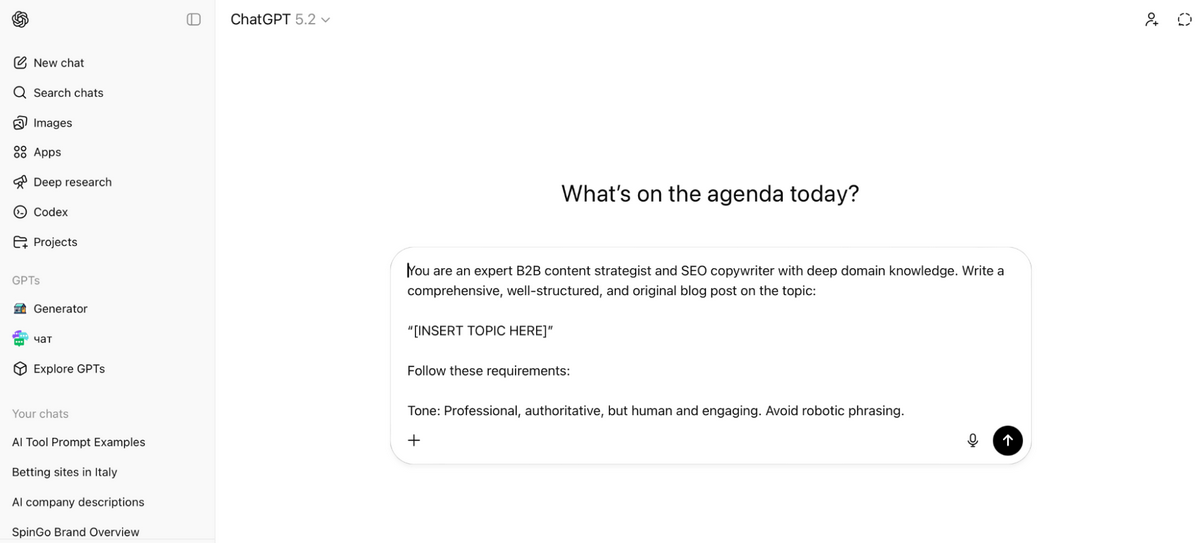
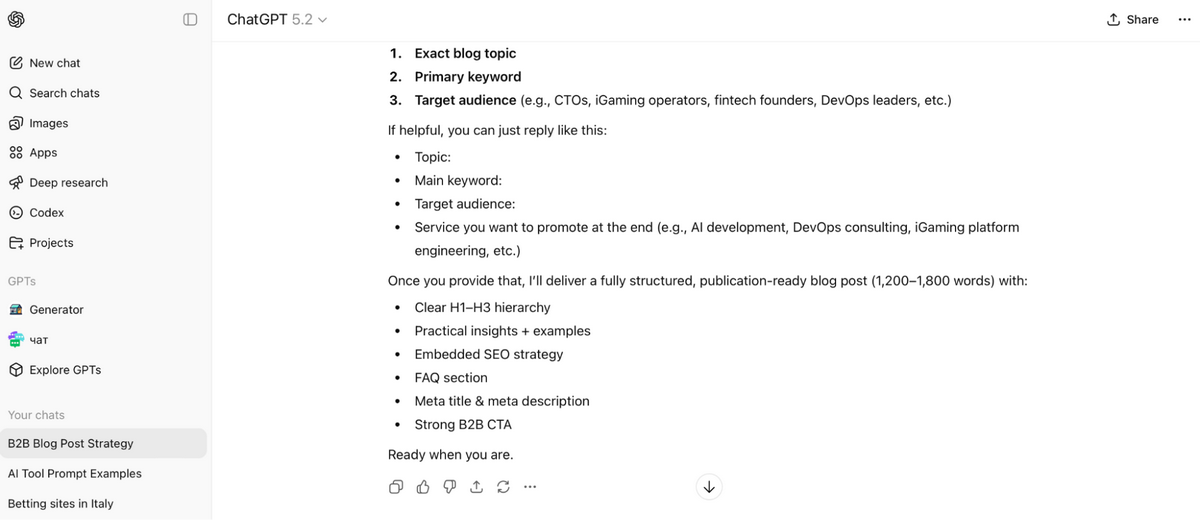
Real Prompt Examples: What High-Quality Prompts Look Like in 2026
By 2026, good prompts look less like “smart questions” and more like small, well-defined system interfaces. They are explicit, testable, and designed to survive scale, edge cases, and handoffs between humans and machines.

Prompts for Automation & Agents
Automation prompts are not about creativity. They are about repeatability, boundaries, and safe execution.
Example: Task-routing agent (operations)
Role: You are an operations routing agent.
Context:
You receive structured task requests from internal systems.
Each request contains: task_type, priority, department, and metadata.
Objective:
Decide whether the task can be handled automatically or must be escalated to a human.
Rules:
- If task_type is "refund" AND amount > 500 → escalate.
- If required metadata is missing → escalate.
- Never invent missing fields.
- Return only valid JSON.
Output format:
{
"decision": "auto" | "escalate",
"reason": "
"required_human_role": "
}
Prompts for Customer Support
Example: Tier-1 support assistant (finance)
Role: You are a Tier-1 customer support assistant for a fintech product.
Context:
You respond only using the provided knowledge base excerpts.
If the answer is not present, you must escalate.
Guidelines:
- Be calm and professional.
- Do not speculate.
- Do not mention internal policies.
- Never provide legal or financial advice.
Task:
Answer the user’s question using the knowledge base below.
Knowledge base:
<<<
[KB_EXCERPTS]
>>>
Output:
- A short, clear answer (max 120 words)
- If escalation is needed, say: "I’m transferring this to a specialist."
Strong support prompts assume uncertainty and plans for it.
Prompts for Research & Analysis
Research prompts benefit from explicit thinking steps, but still need guardrails to avoid overconfidence.
Example: Competitive analysis assistant
Role: You are a research analyst.
Objective:
Compare two products based on publicly available information.
Method:
- List known facts for each product.
- Identify gaps or unknowns.
- Compare only overlapping capabilities.
- State assumptions explicitly.
Constraints:
- Do not infer pricing unless stated.
- Do not rank unless criteria are defined.
- Cite uncertainty where data is missing.
Output structure:
- Facts
- Comparison table
- Risks and unknowns
- Summary (max 5 bullet points)
In practice, the best research prompts read more like analysis briefs than questions.
When to Switch from Prompt Engineering to Fine-Tuning?
Prompt engineering is usually the right starting point. It’s fast, flexible, and surprisingly powerful when the problem is well-bounded. But there’s a point where prompts stop giving reliable gains — and that’s typically when variance, scale, or domain specificity becomes the bottleneck. A few practical signals teams see in real systems:
- Prompt complexity keeps growing, but output quality plateaus.
- Small wording changes cause large output swings.
- You’re solving the same task thousands of times per day and care more about consistency than flexibility.
- The domain language is narrow and repetitive (financial calls, legal clauses, medical notes, internal taxonomies).
- Human QA effort doesn’t go down, even after multiple prompt iterations.

Fine-tuning becomes justified when:
- The task is stable and well-defined.
- You have enough high-quality examples.
- The cost of occasional errors is higher than the cost of maintaining a trained model.
In short, prompting optimizes behavior. Fine-tuning shapes the model itself. When behavior control alone isn’t enough, it’s time to move deeper.

Nataliia Brynza
Chief Operating Officer
Conclusion
If there’s one mistake teams keep making, it’s treating prompt engineering and fine-tuning as competing strategies. In practice, they work best together, at different stages of maturity. A pragmatic approach looks like this:
- Start with prompt engineering to validate the task, surface edge cases, and understand failure modes.
- Use prompts to define clear success criteria before touching training data.
- Move to fine-tuning only when the task is stable, repeatable, and business-critical.
- Keep prompts even after fine-tuning — they remain useful for orchestration, routing, and policy control.
- Design everything with auditability and rollback in mind. You will need both.
If your AI roadmap is starting to feel fragile or overengineered, that’s usually a sign to step back and ask a simpler question, “Are we shaping the system — or just reacting to it?” Also, it is a sign that you may need AI agent development from Artjoker - contact us today!
Similar articles
View all


your business
together
- PROJECT INQUIRIES info@artjoker.net
- CALL US +1 213 423 05 84
contact us:
 USA
USA
 Estonia
 Ukraine
 Norway