How Does Cloud Computing Help Businesses Reduce Costs Without Sacrificing Performance?


 5 (1 reviews)

In 2025, businesses aren’t just looking to scale – they’re looking to scale smart. Infrastructure, compute power, and storage are critical, but no company wants to burn cash doing it. That’s why so many teams are turning to distributed environment solutions – not just for agility, but to reduce cloud costs without slowing down operations.
The right approach to distributed environment computing can streamline infrastructure, eliminate waste, and reduce cloud spend across the board – whether you're running on AWS, Azure, Google, or a hybrid setup. But saving money in the distributed environment isn’t automatic. You need the right strategies, tools, and architecture to make it work.
In this guide, we’ll break down how on-demand platform computing helps businesses lower costs, where most companies overspend, and how to build a lean, cost-efficient infrastructure that performs at scale.
Why Reducing Cloud Costs Is a Strategic Priority in 2025?
In 2025, on-demand platform spending is no longer a back-office concern – it’s a boardroom conversation. As on-demand platform adoption grows across every industry, so do the bills. Businesses are realizing that without active cost control, on-demand platform expenses can spiral fast, eating into margins and stalling innovation.

Reducing on-demand platform waste isn’t just a technical adjustment – it’s a strategic move that frees up budget for growth, product development, and talent. For both startups and enterprises, managing on-demand platform spend is now a critical part of staying competitive.
Expert Opinion «Saving on infrastructure isn’t just about trimming budgets – it’s about realigning your tech to drive more value with less waste. At Artjoker, we work with companies to optimize not only their systems but their strategy. When you reduce unnecessary overhead, you’re not just cutting costs – you’re creating space to innovate, scale, and outperform competitors. That’s the power of smart infrastructure decisions.»Oleksandr Prokopiev CEO, Artjoker

How Cloud Computing Reduces IT Infrastructure Cost?
One of the clearest advantages of on-demand platform adoption is its ability to eliminate upfront hardware expenses and long-term maintenance. Instead of buying servers, companies can provision resources on-demand and only pay for what they use. That’s how cloud computing reduces costs for modern businesses.
More importantly, cloud computing reduce cost in your company by automating updates, reducing downtime, and eliminating the need for large in-house IT teams managing physical infrastructure. It replaces CapEx with OpEx – giving businesses financial agility without sacrificing performance.
Why Cloud Services Help Businesses Keep IT Costs Down
Cloud platforms make it easier than ever to scale efficiently, track usage, and optimize performance based on real-time demand. Whether you’re running production apps or managing backups, cloud services help businesses keep IT costs down by offering granular control over every resource you deploy.
Additionally, cloud services help reduce costs through built-in features like auto-scaling, rightsizing recommendations, and pay-as-you-go pricing. And with growing adoption of microservices and containers, businesses can further cut waste by running leaner environments optimized for efficiency.
Lower Cloud Costs without Losing Performance
We analyze your cloud stack and uncover wasted spend.
Get Cost OptimizationWhere Businesses Overspend – Key Cloud Cost Drivers?
Overspending in the distributed environment usually doesn’t come from a single mistake – it’s death by a thousand cuts. The top culprits? Unused resources, overprovisioned virtual machines, lack of visibility, and poor architecture planning. While the distributed environment promises flexibility, that same flexibility often leads to budget waste if left unchecked.
For example, some businesses forget to clean up idle dev/test environments or leave instances running after hours. Others deploy overly powerful instances "just in case." This is where cloud computing reduces IT infrastructure cost in theory, but only when used correctly.
The good news? Cloud services reduce cost when paired with smart governance, automation, and regular audits. Identifying these common overspending patterns is the first step toward fixing them.
Cloud Cost Optimization Strategies
Distributed environment optimization isn’t just a one-time fix – it’s an ongoing mindset. From adjusting compute instances to building smarter pipelines, it’s all about aligning your distributed environment usage with your actual business needs.

Cloud Cost Optimization Strategies for Small Businesses
Small businesses often don’t have huge budgets – or large IT teams to monitor distributed environment usage daily. That’s why cloud cost optimization strategies for small businesses focus on simplicity: consolidate workloads, use built-in analytics, and pick pricing models that scale gradually.
For these teams, every dollar matters. Partnering with the right provider and using reserved instances or savings plans can make a huge difference without complicating your setup.
Rightsizing and Auto-Scaling to Reduce Cloud Computing Expenses
It’s easy to overspend by provisioning more resources than you need. Rightsizing involves analyzing your workloads and adjusting them to match actual usage. Auto-scaling, on the other hand, ensures your resources grow or shrink depending on demand.
Together, these techniques can reduce cloud computing expenses drastically, without impacting performance.
Choosing the Right Cloud Model to Reduce Cost of Cloud
Not all workloads need the same treatment. Picking the wrong service model (IaaS, PaaS, or SaaS) can lead to inflated bills or unnecessary complexity.
Choosing correctly helps reduce cloud computing costs, especially when workloads are aligned with the right compute resources. For example, using PaaS for internal tools or microservices often costs less than building and maintaining full-stack infrastructure.
Scheduling Non-Critical Workloads to Reduce Cloud Spend
Running backups, batch jobs, or data pipelines 24/7? Probably not necessary. By scheduling these non-critical tasks during off-peak hours or turning them off entirely when not in use, you can reduce distributed environment spend without affecting user-facing systems.
And if you're on AWS, setting up automation scripts can go a long way to reduce AWS cloud costs over time.
How Multiple Clouds Reduce Cost Through Vendor Flexibility?
Multi-distributed environment strategies are about more than redundancy – they’re about leverage. Businesses can reduce cloud infrastructure cost by selecting providers that offer better regional pricing or feature-specific discounts.
Plus, vendor diversity gives you the ability to shift workloads based on performance, price, or legal requirements. In some cases, reducing AWS cloud cost becomes easier when offloading non-critical services to a cheaper or more specialized provider.
Reducing Costs with Cloud Computing Services
Smart use of distributed environment services isn’t just about cutting costs – it’s about doing more with less. With the right approach, businesses can reduce expenses, stay agile, and avoid the classic pitfalls of rigid infrastructure and bloated IT budgets.
How Cloud Services Help Reduce Costs While Improving Agility
The real power of the distributed environment lies in its elasticity. You can scale up when demand spikes, scale down when it drops, and pay only for what you use. That alone saves businesses thousands in unused capacity.
In fact, AWS cloud computing help businesses reduce costs by offering tools like auto-scaling, spot instances, and pay-as-you-go pricing – all while giving you the flexibility to move faster than traditional infrastructure ever could.
And during a digital transition, managing your budget becomes even more critical. You can reduce cloud migration costs by pre-planning resource allocation and avoiding expensive lift-and-shift mistakes.
Cloud Strategy That Reduces Costs Without Downtime
The biggest mistake many businesses make? Treating the distributed environment like a simple hosting platform. With a real strategy in place, the cloud can become a profit center instead of a cost center.
A well-structured cloud strategy reduces costs by focusing on right-sizing, automation, and prioritizing workloads that benefit most from the distributed environment.
For companies juggling providers or compliance across regions, multiple clouds reduce cost by letting you choose the most competitive offer for each piece of your stack, without tying you to a single vendor’s pricing model.
How to Reduce Cloud Infrastructure Cost with Serverless and Containers
Going serverless means you don’t pay for idle time – you’re only billed when your code actually runs. Containers, meanwhile, let you pack apps tighter, improving resource efficiency without sacrificing performance.
Want a real-world example? You can reduce Azure cloud costs by shifting to Azure Functions or containerizing workloads using AKS (Azure Kubernetes Service). Likewise, smart storage tiering and usage monitoring can reduce cloud storage costs, especially for cold or archived data.
Bottom line: whether you're trying to reduce cost of cloud or optimize compute usage, serverless and containers give you granular control over performance, spend, and scalability.
And if you’re invested in Google’s ecosystem, don’t overlook their aggressive discounts. With options like Sustained Use Discounts and Preemptible VMs, it’s possible to reduce Google Cloud cost significantly, without touching your application code.
AWS, Azure, or Google Cloud – Where Can You Save the Most?
When it comes to cutting IT expenses and maximizing performance, not all platforms are created equal. AWS, Azure, and Google each bring their own flavor of pricing models, automation tools, and flexibility – so choosing the right one can seriously impact your bottom line.
Whether you're scaling up workloads, managing distributed teams, or trying to minimize idle infrastructure, understanding how each provider helps reduce spend is crucial. Here's a side-by-side breakdown to help you decide where your money works hardest.
| Platform | Cost-Saving Features | Best Use Cases |
|---|---|---|
| AWS |
|
|
| Azure |
|
|
|
|
Reduce AWS Cloud Costs with Native Tools and Pricing Models
If you're running on Amazon, take advantage of built-in savings. Features like Spot Instances, Savings Plans, and Reserved Instances can lead to reducing costs with cloud computing by up to 90% compared to on-demand pricing. Combine that with budgeting tools from native billing dashboards and AWS DevOps services, and you’ll stay on top of spend while maintaining high availability.
Reduce Azure Cloud Costs Through Hybrid Licensing and Reservations
Microsoft makes it easy to reuse existing investments. If you're already paying for Windows Server or SQL Server licenses, the Hybrid Benefit lets you maximize those investments. Add in Reserved Instances and automated scaling, and you're reducing cloud price while keeping enterprise support in place.
Reduce Google Cloud Cost with Sustained Use Discounts and Preemptible VMs
Google’s billing model rewards consistency. With Sustained Use Discounts and ultra-cheap Preemptible VMs, your long-running workloads can optimize costs without any manual intervention. This is perfect for container-driven environments or heavy data processing.
What Is Your Cloud Really Costing You?
Get a personalized cloud efficiency report from our FinOps Architects.
Get Cloud Cost ReviewHow to Reduce Cloud Migration Costs Without Compromising Results
Migrating data or applications doesn't have to be expensive or risky. With the right process, you can move confidently and cost-efficiently.
Cloud Readiness Assessment for Cost Efficiency
Before migrating, conduct a full inventory of applications and infrastructure. Understand which components can move as-is and which need refactoring. This type of assessment is crucial to benefits of using cloud computing in business, ensuring you don’t pay unnecessarily for resources you don’t use.
Minimizing Downtime to Reduce Cloud Migration Costs
Every minute of downtime during migration is lost revenue. To avoid this, use staged rollouts, blue-green deployments, and migration tools that sync data in real time. Proper planning helps how to choose a cloud service provider, ensuring you pick a platform with robust migration support.
Bonus tip: if you're building a distributed environment native architecture, consider hiring professionals who know the terrain well – like hire AWS developers or engineers with Kubernetes expertise for Kubernetes cost optimization. That way you save time, avoid mistakes, and reduce your overall migration bill.
Checklist: How to Reduce Cloud Computing Costs in Your Company?
Want to tighten up your budget without cutting corners? Start here:
- Audit your infrastructure usage regularly and eliminate waste.
- Turn off non-critical resources outside business hours.
- Use auto-scaling to match usage with demand.
- Opt for long-term pricing plans where possible.
- Leverage lightweight services and serverless when practical.
- Clean up unused storage, backups, and outdated environments.
- Set up alerts for usage spikes to catch anomalies fast.
- Benchmark regularly and adjust your stack based on performance vs. cost.
Can AI Help You Reduce Cloud Spend Further?
Absolutely. AI isn’t just for analytics – it can actively help you optimize how your infrastructure runs. Smart monitoring tools use machine learning to predict demand, spot inefficiencies, and make adjustments in real time. That means fewer surprises on your bill and more consistency in how your systems perform. From automated resource allocation to predictive scaling, AI turns manual cost control into a hands-off process.
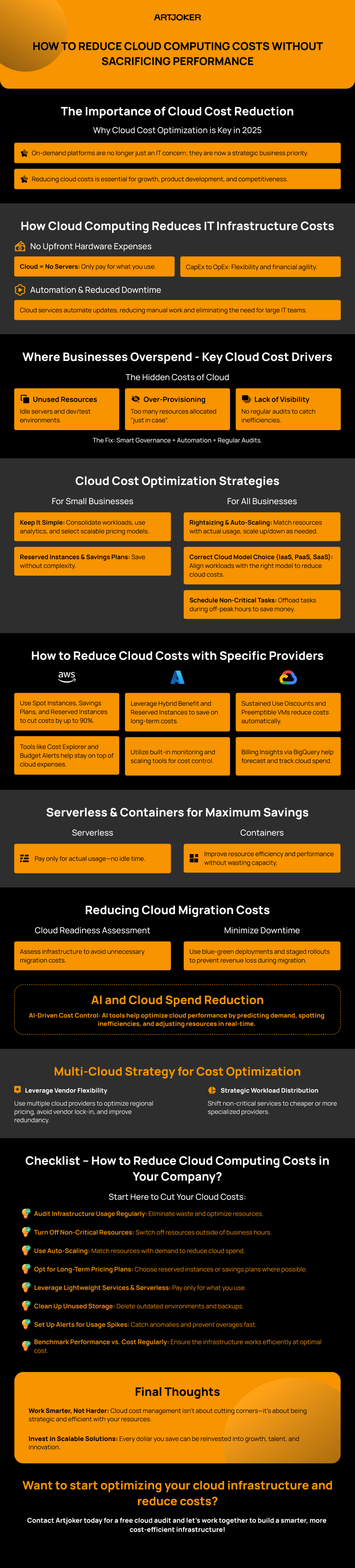
No time to read the whole article? Here’s the infographic with all the important points from the article.
Case Study: How Infrastructure Modernization Transformed a Crypto Platform?
Artjoker recently teamed up with a fast-growing fintech company in Germany running a cryptocurrency exchange platform. Their team was struggling with outdated systems – manual infrastructure setup, inconsistent deployments, and poor scalability. Performance bottlenecks and security concerns made it clear: they had outgrown their legacy architecture.
To fix this, we led a full DevOps overhaul. Using Terraform, AWS services, and GitLab CI/CD, we reengineered their backend with automation, modern deployment methods, and dynamic scalability in mind.
Here’s what we delivered:
- Automated infrastructure provisioning with Infrastructure as Code
- A serverless setup to minimize overhead and auto-scale with demand
- CI/CD pipelines integrated with automated testing and quality gates
- Seamless deployment of modern services like EC2, IAM, Lambda, and Cognito
What changed:
- Deployment time dropped by 50x
- System throughput skyrocketed by 320%
- Infrastructure management became fully automated
- Security and compliance improved significantly
- The system now scales effortlessly in response to user activity
This transformation wasn’t just a tech upgrade – it became a foundation for long-term growth. By modernizing their infrastructure, the client unlocked the speed, resilience, and flexibility they needed to compete in a high-stakes industry. That’s what happens when DevOps meets strategic execution.
Why Businesses Choose Artjoker for DevOps and Infrastructure Solutions
At Artjoker, we don’t just build software – we engineer business outcomes. Whether you’re modernizing infrastructure, scaling operations, or optimizing your DevOps pipeline, we deliver with precision, speed, and a business-first mindset.
What sets us apart:
- Adaptability in action – We adjust quickly as your goals evolve. No red tape, no delays.
- End-to-end expertise – From architecture to deployment, our full-stack teams know how to build resilient, scalable systems.
- Proactive communication – You won’t be left wondering where things stand. We stay responsive and transparent throughout the project.
- On-time, on-point delivery – We hit deadlines without cutting corners.
But don’t just take our word for it. Here’s what one of our clients had to say:
Expert Opinion «Artjoker has been very adaptive to the job and has accommodated where the brief changed. They are attentive and considerate and deliver to a high standard and on time.»Head of Development, Digital Agency, United Kingdom
When you partner with Artjoker, you’re not just getting a vendor – you’re gaining a strategic ally who’s in it for the long haul. Let’s build something powerful together.
What are the most effective ways to reduce cloud computing costs without performance loss?
The best approach combines right-sizing resources, using auto-scaling, and shutting down idle services. You should also review your pricing model – reserved instances or savings plans often cut costs significantly. Monitoring usage trends and setting up automated alerts helps prevent overages without affecting performance.
How can small businesses reduce their cloud spend quickly?
Start by identifying unused or underutilized resources – this is often low-hanging fruit. Downgrade over-provisioned instances, take advantage of free tiers, and schedule workloads to run only during business hours. Many providers also offer startup credits and discounts worth exploring.
What AWS tools help reduce cloud costs automatically?
AWS offers several native tools:
- AWS Cost Explorer for budget tracking and forecasts
- AWS Compute Optimizer for identifying underused resources
- AWS Trusted Advisor for cost-saving recommendations
- Savings Plans and Reserved Instances for long-term discounts
Pairing these with infrastructure-as-code and auto-scaling ensures you only pay for what you need.
Is using multiple clouds a real strategy to reduce total cloud price?
It can be – if done right. Multi-cloud strategies let you shop around for the best pricing on specific services, avoid vendor lock-in, and improve redundancy. But it also introduces complexity. Make sure your team or partner has the expertise to manage the added overhead effectively.
How do I reduce costs during and after cloud migration?
Before migration, conduct a readiness assessment to avoid moving unnecessary workloads. During the process, phase in deployments to minimize downtime. After migration, clean up any leftover legacy services and implement governance policies to monitor spending. Tools like tagging and cost allocation reports help track who’s using what – and why.
- Why Reducing Cloud Costs Is a Strategic Priority in 2025?
- Where Businesses Overspend – Key Cloud Cost Drivers?
- Cloud Cost Optimization Strategies
- Reducing Costs with Cloud Computing Services
- AWS, Azure, or Google Cloud – Where Can You Save the Most?
- How to Reduce Cloud Migration Costs Without Compromising Results
- Checklist: How to Reduce Cloud Computing Costs in Your Company?
- Can AI Help You Reduce Cloud Spend Further?
- Case Study: How Infrastructure Modernization Transformed a Crypto Platform?
- Why Businesses Choose Artjoker for DevOps and Infrastructure Solutions

Nataliia Brynza
Chief Operating Officer
Conclusion
Reducing IT costs isn't about cutting corners – it’s about working smarter. With the right mix of automation, insight, and planning, you can bring expenses down while still delivering the performance your users expect. Whether you're running lean or scaling fast, every dollar you save here is a dollar you can invest in innovation, talent, or growth. Start optimizing today and future-proof your operations without compromising on speed or reliability. Contact us today!
Similar articles
View all


your business
together
- PROJECT INQUIRIES info@artjoker.net
- CALL US +1 213 423 05 84
contact us:
 USA
USA
 Estonia
 Ukraine
 Norway