How to Use Generative AI for Software Development?


 0 (0 reviews)
Generative artificial intelligence is a practical tool that changes how companies design, build, and deploy software. Businesses use it to accelerate coding, improve testing, and even support web development with automated UI generation. Knowing how to use generative AI for software development is now a competitive advantage.
In this article, we’ll explore why companies adopt it, the main advantages, its impact on the software development lifecycle, and what the future of the industry looks like with GenAI.
Why Businesses Should Pay Attention to Generative AI in Software Development?
Generative artificial intelligence is already reshaping IT. Gartner’s experts suggest that in 2028, 75% of enterprise software engineers will use coding assistants daily. Companies that adopt early see faster delivery and reduced costs.
But the value is not only speed. It enables:
- Scalable product design — from MVPs to enterprise apps.
- Smarter testing with generated test cases.
- Personalized digital experiences, especially in generative AI in financial services, where compliance and customer trust are critical.
Expert Opinion «It is not replacing developers — it gives teams tools to experiment, automate, and launch products faster.»Oleksandr Prokopiev CEO of ArtJoker

For companies planning digital transformation, this is not optional. It’s a practical path to stay ahead in the future of software development with generative AI.
Advantages of Generative AI in Software Development
Using generative AI for effective software development, companies can get clear and measurable advantages. Unlike traditional automation, GenAI learns patterns, adapts, and generates new solutions.
Key Advantages:
- Faster delivery. Assisted coding speeds up software delivery by 20–45%, depending on specific tasks.
- Improved quality. Artificial intelligence suggests bug fixes and generates test cases, cutting QA time by up to 30%.
- Lower costs. By automating standardized tasks, companies can reduce development expenses by 15–20%.
- Flexibility. Teams can use generative AI for product development, prototyping, or even web development.
- Innovation. Developers gain time to focus on architecture and creative problem-solving instead of routine coding.
For enterprises, this means staying competitive. Startups use these tools to release MVPs faster, while corporations rely on generative AI development services to modernize existing systems. In practice, if you use generative AI in software development, you cut timelines, boost reliability, and open new growth opportunities, rather than chasing hype.

The Impact of Generative AI on Software Development Lifecycle
Generative artificial intelligence is changing every stage of the development process. From idea to deployment, GenAI shortens cycles, automates routine work, and improves decision-making.
Key Lifecycle Impacts:
- Planning & design. Teams use gen AI in software development to generate architecture drafts, user flows, and mockups in hours, not weeks.
- Coding. Large language models autocomplete functions, refactor legacy code, and adapt snippets across frameworks. For teams using GitHub Copilot, about 30–40% of committed code is AI-generated.
- Testing. Artificial intelligence creates automated test cases, simulates edge scenarios, and reduces QA bottlenecks.
- Deployment. Integrated with CI/CD pipelines, it predicts risks, optimizes cloud resources, and ensures smoother releases.
- Maintenance. By analyzing logs, artificial intelligence detects anomalies early, preventing failures and downtime.
For example, generative AI consulting services help enterprises redesign workflows, while fintech companies rely on it to automate compliance and fraud detection.
The impact of generative AI on the software development lifecycle is clear: projects move faster, with fewer bugs, and require fewer manual interventions. Businesses that adopt GenAI today reduce risks and create more scalable products tomorrow.
Generative AI Works Best Inside Real Workflows
We apply GenAI to coding, testing, and documentation safely.
Talk to AI TeamFuture of Software Development with Generative AI
The future of software engineering will not be about writing every line of code manually. Developers will manage ecosystems of automated tools, focusing on strategy, architecture, and ethical decisions.
Instead of spending hours on syntax, teams will shift their energy toward problem-solving, system design, and deep domain expertise. For front-end teams, generative AI for web development accelerates UI scaffolding, component generation, and accessibility reviews, so engineers spend more time on product. This transformation changes the very definition of what it means to be a developer.
Expert Opinion «The role of artificial intelligence in software development is not just about efficiency — it forces us to rethink what creativity and responsibility mean in tech. Developers are no longer only engineers; they are curators of machine intelligence.»Oleksandr Prokopiev CEO of ArtJoker
For startups, access to such services offers a shortcut to compete at scale. Businesses at scale can balance innovation and velocity with the safeguards of compliance through GenAI. And it is not just on the horizon — it’s already here. Stanford’s 2025 AI Index shows that 78% of organizations used artificial intelligence in 2024, up from 55% a year earlier.
Companies that adapt now will lead tomorrow’s digital economy.
ArtJoker Success Stories: How Companies Use Generative AI in Software Projects?
Real results beat theory. Below are three generative AI use cases in software development that show how GenAI moves the needle in production.
Case Study 1: LeadStream — AI Chatbot for Omnichannel Customer Requests (SMB)
Goal: Centralize customer inquiries from Instagram, Messenger, Telegram, WhatsApp, and email. Cut response time. Remove manual spam cleanup.
What we built: A custom chatbot and unified communication hub with CRM integration, powered by LLMs for auto-responses and sorting. Deployed with Docker, Nginx/Traefik, PostgreSQL, Prometheus + Grafana. From concept to production in 2 weeks.
Why it matters: It is generative AI for software developers in action: the bot drafts relevant replies, classifies intents, and routes leads.
Results:
- +30% operational efficiency via centralized management.
- –25% response time thanks to automated routing and suggested replies.
- –50% time on spam filtering, teams focus on real customers.
If you want the same acceleration, use generative artificial intelligence to scope the workflow and ROI.

Case Study 2: DigestAI — Slack Summaries with LLMs (Enterprise Teams)
Goal: Stop losing context in long Slack threads. Give managers daily summaries across channels without data leaving Slack.
What we built: DigestAI, a Slack bot that uses transformers to generate multilingual conversation summaries, runs fully inside the workspace for privacy. Stack: Python, Slack API, cloud hosting, NLP transformers.
Why it matters: A concrete example of GenAI that removes routine. Teams get the “what changed and why” in seconds.
Results:
- Higher productivity;
- Better cross-language cllaboration;
- Secure data handling inside Slack without external storage;
- Quick team adoption thanks to a simple on-demand interface.
Exploring similar assistants for PM/DevOps? You can hire generative AI developers from ArtJoker to embed GenAI into daily tools.
Is Generative AI Worth the Investment?
Evaluate impact, cost, and risks before scaling.
Evaluate ROICase Study 3: CallChecker — AI Quality Control for 70,000 Calls/Month (Fintech)
Goal: MyCredit needed to improve call-center quality without extra headcount. Supervisors could check ~250 calls/day (~7,500/month) out of 70,000 total — most calls were never reviewed.
What we built: A pipeline that ingests recordings, transcribes them, and uses LLM prompts to evaluate compliance and tone. Built scoring per call and per manager; dashboards, department-level filters, and pre-moderation rules (length, silence, profanity, key phrases). Integrated with telephony, OpenAI API, Reiv, AWS (S3, Lambda), and CI/CD on GitLab.
Why it matters: It is generative AI in product development for operations: automatic transcripts and structured insights let supervisors review more calls with the same team.
Result: A working quality-assurance system with automated scoring, topic detection, and manager analytics, turning raw audio into actionable QA signals.
Takeaway
These projects show how generative AI for software development gives you measurable impact: faster response times, fewer manual steps, and better visibility. If you’re mapping the impact of generative artificial intelligence on the software development lifecycle, start with a small, high-leverage workflow (chat, QA, summaries), then expand into broader product surfaces.
Expert Opinion «When we integrated GenAI into customer support and QA flows, the results were immediate: teams cut resolution time almost in half and released new features faster. That’s the kind of outcome businesses should expect if they approach tech adoption step by step.»Oleksandr Prokopiev CEO of ArtJoker
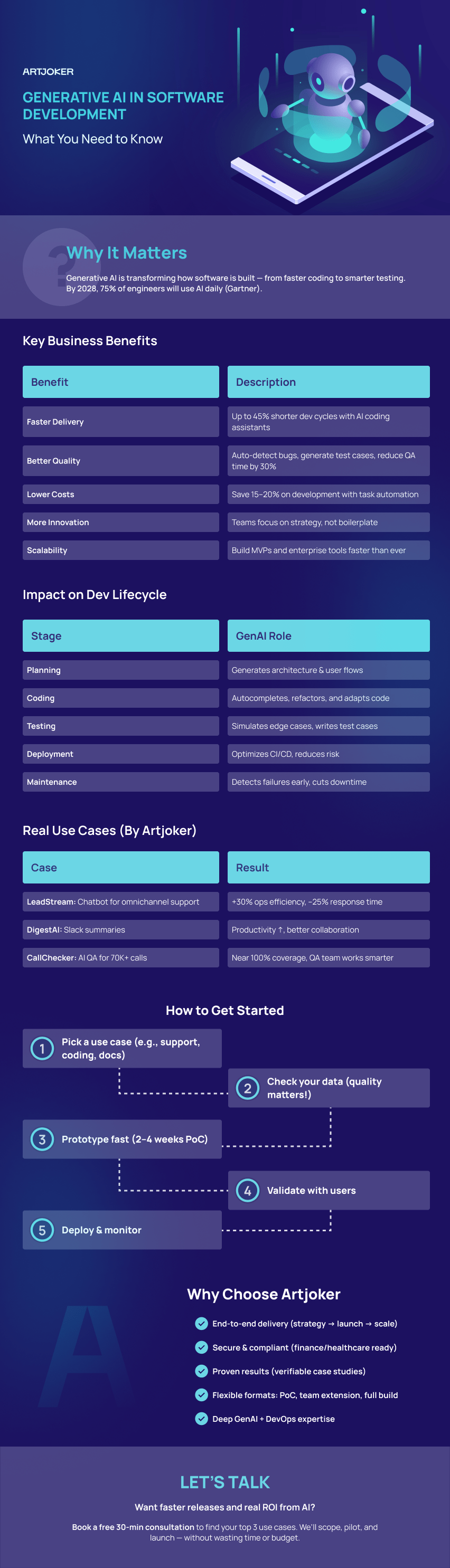
No time to read the whole article? Here’s the infographic with all the important points from the article.
How to Start Using Generative AI for Your Next Software Project?
Jumping into this tech sector without a plan is risky. Success starts with a clear plan, not with chasing hype. Deep expertise in Gen AI for software development is not mandatory, since the field is evolving so quickly that even leading teams are learning on the go. But with the right experts, you move quicker and sidestep costly errors.
Choosing the Right Partner for Generative AI Development
Not every software vendor is ready for such projects. You need a partner who:
- Understands artificial intelligence in software development beyond theory and has delivered real projects.
- Can evaluate data readiness, model choice, and compliance needs.
- Offers full-cycle support: discovery, prototyping, deployment, and monitoring.
This reduces the risk of wasted budgets and ensures that outputs are explainable, secure, and aligned with regulations.
Practical Steps: From Idea to Implementation
Getting started doesn’t mean building a system from scratch. The path usually looks like this:
- Identify a clear use case. Focus on one bottleneck — e.g., customer requests, document processing, or code generation.
- Assess available data. The quality and volume of text, audio, or logs decide what’s possible.
- Prototype quickly. Use APIs or frameworks to test if the model works for your scenario.
- Validate with users. Early feedback shows whether the solution reduces workload or adds friction.
- Plan deployment. Integrate into existing tools, monitor results, and define guardrails for compliance and bias.
Instead of chasing a “big launch,” focus on iterative wins that compound over time — each small success makes the next rollout faster and less risky. For a bigger picture of the stack and risks, read our guide about the advantages of generative AI in software development.
Why Work with Us?
You need a partner who ships real products. ArtJoker covers strategy, delivery, and long-term operations — so GenAI turns into business value, not debt. Choosing us for development services, you get the following benefits:
- End-to-end ownership. From discovery and model choice to deployment, monitoring, and optimization — we run the full loop, including MLOps and retraining. It is our standard end-to-end support.
- Security & compliance. Data handling, access controls, audit trails, and regulatory guardrails are integrated, especially for finance and regulated domains. Our services emphasize security and compliance by design.
- Proven track record. We deliver artificial intelligence projects across industries and publish detailed case studies you can verify. Check the portfolio to see scope, stacks, and outcomes.
- Flexible engagement. Dedicated teams, team extension, or project-based — pick what fits your roadmap and budget. You can start small with a PoC and scale fast.
- Deep expertise. LLMs, NLP, predictive analytics, and accelerators that shorten time-to-value backed by engineers who know delivery, not just research.
At ArtJoker, we deliver full-cycle turnkey solutions with no gaps. We begin with consulting to validate your case and ROI. Then our team drives end-to-end development to launch solutions that actually work. Need scale and speed? With dedicated developers, we make sure your product evolves and grows without delays.
- Why Businesses Should Pay Attention to Generative AI in Software Development?
- Advantages of Generative AI in Software Development
- The Impact of Generative AI on Software Development Lifecycle
- Future of Software Development with Generative AI
- ArtJoker Success Stories: How Companies Use Generative AI in Software Projects?
- How to Start Using Generative AI for Your Next Software Project?

Nataliia Brynza
Chief Operating Officer
Conclusion
Generative AI isn’t just a trend — it’s reshaping how modern software is built, tested, and scaled. Whether you're a startup looking to deliver faster MVPs, or an enterprise optimizing internal processes, the key to success lies in a focused, practical approach.
At Artjoker, we help companies like yours turn GenAI potential into working solutions — with real results in weeks, not months. Book a free 30–45 min session — we’ll help you identify the best use case, assess your data, and map out a fast, low-risk PoC roadmap.
Similar articles
View all


your business
together
- PROJECT INQUIRIES info@artjoker.net
- CALL US +1 213 423 05 84
contact us:
 USA
USA
 Estonia
 Ukraine
 Norway