AI in Software Development: Benefits, Risks, Trends and How It Will Change the Industry


 0 (0 reviews)
Artificial intelligence is here. It is changing how companies build software. Tools like GitHub Copilot, ChatGPT, Cursor, and DevOps pipelines have moved from experiments to daily practice. Businesses that use AI in software development save time, improve code quality, and speed up releases.
Expert Opinion «Artificial intelligence has become a must-have tool in modern IT. Companies that adopt it early get a real advantage. Those who ignore it risk falling behind.»Oleksandr Prokopiev CEO of Artjoker

In this article, we review the main benefits, the risks, and the impact of AI on software development across planning, coding, testing, and operations. We also look at trends that will shape the future. If you want practical tactics, check our guide on generative AI for software development.
Key Benefits of Using AI in Software Development
Artificial intelligence brings value to nearly every step of the development process. Here are the most important benefits of AI in software development that companies already notice.
1. Faster coding and development cycles
Assistants like Copilot generate snippets, suggest fixes, and handle routine tasks. Developers focus on hard problems instead of boilerplate. Projects move faster. Deadlines are easier to meet. Teams deliver more in the same timeframe.
2. Early bug detection and better quality assurance
Testing tools scan code, detect vulnerabilities, and predict where bugs may appear. Unlike traditional QA, they learn from past issues. The payoff: fewer post-release incidents, lower maintenance costs, and higher customer trust.

3. Cost reduction in QA and DevOps
Artificial intelligence automates repetitive test cases, CI/CD monitoring, and even performance tuning. Less manual toil means lower OPEX and higher throughput. At scale, this cuts expenses significantly. This is the clearest AI effect on software development: less grunt work, more velocity.
4. Smarter project planning
New technology forecasts workloads, tracks dependencies, and flags sprint risks. Fewer surprises for managers. Better decisions for teams. Predictive planning makes pipelines steadier and keeps everyone aligned. Artjoker offers AI development services to integrate these predictive tools into daily workflows.
5. More secure software
Threats grow every year. Smart systems analyze code and user behavior in real time to flag suspicious actions. Teams act before risks turn into breaches.
AI Accelerates Development when Applied Correctly
We help teams adopt AI responsibly without increasing technical debt.
Talk to AI ExpertsRisks and Challenges of AI in Software Development
Artificial intelligence gives speed, but it also adds new risks. To use it well, companies must balance innovation with control. Here are the key risks of using AI in software development that professionals should keep a close eye on:
- Bias and unreliable outputs. Tools learn from large datasets. If the data is flawed, the results inherit those flaws. Biased code suggestions or wrong predictions can harm projects. Developers need human review at every step.
- Security vulnerabilities. Code generators may include unsafe snippets or outdated libraries. Attackers can exploit these gaps. Companies must combine automated coding with strict code review and modern security audits.
- Intellectual property concerns. Who owns generated code? This is still a gray area. Some open-source communities challenge the legality of training data. Businesses must stay cautious and check compliance. An internal audit of software development services helps reduce the risk. It ensures that all libraries, models, and outputs align with legal and licensing rules.
- Dependency and skill erosion. Over-reliance on Cursor or Copilot-like tools can weaken developer skills. New engineers may fail to learn fundamentals. A balanced workflow keeps the automated tool as an assistant, not a replacement.
- Data privacy and compliance. Artificial intelligence platforms often process sensitive information. Without controls, customer data may leak to third parties. For teams handling finance or healthcare apps, this is critical. GDPR and HIPAA compliance checks remain mandatory.
How Does AI Affect Software Development?
AI changes software development end-to-end. Developers spend less time on routine tasks and more on design, testing, and innovation. Managers see faster delivery and better team coordination. For companies, this means shorter time-to-market and lower costs. Artificial intelligence helps modernize workflows and keep teams competitive.
Here are some proofs:
- A McKinsey study shows it can cut software development time by 20–45%, depending on task complexity.
- According to Gartner, by 2028, more than 75% of enterprise software engineers will use coding assistants daily, compared to less than 10% in 2023.
- In DevOps, Forrester reports that companies using automated monitoring reduce downtime incidents by up to 60%. This allows them to save $3.7 million annually.

The Role of AI in Project Management and DevOps
New tools predict workloads, detect bottlenecks, and suggest realistic timelines. In DevOps, they optimize CI/CD pipelines, reduce downtime, and improve system monitoring. Teams can catch issues before they slow down releases. This makes development cycles smoother and more predictable. Businesses using such services benefit from predictive analytics and automated workflows that keep projects on track.
Expert Opinion «The role of AI in software development is not about replacing engineers — it’s about giving them superpowers»Oleksandr Prokopiev CEO of Artjoker
Use Cases by Industry
Before we get into future prognoses and trends, let’s anchor this to real business value. Below are typical industry use cases we’ve analyzed, each showing how intelligent automation solves concrete problems with measurable results.
Fintech
- Many fintech companies struggle with high drop-off rates during identity verification and anti-money laundering checks (KYC/AML). Long waiting times lead to lost users and increased operational costs. By automating document capture and using artificial intelligence to flag exceptions, businesses reduce onboarding times from days to hours. As a result, manual verification costs typically fall by 30–40%, false positives drop by 10–20%, and more users complete the sign-up process.
- Fraud detection is another persistent pain point. Payment teams often deal with high alert volumes while real threats slip through. Adding intelligent triage systems that prioritize risky transactions helps streamline investigations. This typically cuts case resolution time by 30–40% and improves chargeback outcomes after just a few weeks of implementation.
- Customer support quality monitoring is particularly hard to scale manually. Most teams can only sample a small portion of calls. Automated call analysis now enables full coverage, automatically highlighting compliance risks and surfacing targeted coaching tips. This reduces review time by about a third, ensures consistent service, and allows supervisors to focus on coaching rather than screening.
Retail and eCommerce
- Retailers often lose margin due to slow, manual price updates. Intelligent dynamic pricing systems allow for daily adjustments based on market conditions, while respecting promo and margin rules. Businesses that adopt this approach typically see a 1–3 percentage point increase in margin and smoother inventory movement during promotions and low seasons.
- Product discovery remains a conversion bottleneck. Static recommendations fail to reflect user context or behavior. Artificial intelligence improves relevance in search and recommendations, helping customers find products faster. Even small pilots tend to increase conversion in the low single digits and boost average order value through contextual bundling.
- Returns are another major cost center. Many teams rely on manual parcel sorting and reactive return policies. Artificial intelligence helps flag risky return cases and classify reasons automatically, offering agents next-step guidance. Companies adopting this approach often reduce abusive returns and cut manual handling time by 20–30% while improving logistics efficiency.
Healthcare
- Administrative overhead at check-in is a major bottleneck in many healthcare companies. Front-desk staff frequently re-enter patient data from forms, creating delays and errors. Automating data extraction, with exception handling for edge cases, cuts input time by 60–80% and reduces errors, freeing up nurses for actual patient care.
- In medical billing, long, unstructured clinical notes slow down coders and delay revenue cycles. Automated transcription and summarization tools convert doctor notes into billing-ready formats with suggested codes. This reduces time spent on coding by 20–30% and improves billing consistency across departments.
- Insurance pre-authorization is often delayed due to incomplete submissions. Artificial intelligence can automatically compile insurer-specific packets with the required evidence upfront. This increases first-pass approvals and shortens treatment delays. Within weeks, the positive impact is often strong enough to warrant wider rollout.
Quick-Glance Integration Matrix
Curious about effects and timelines? Use this cross-industry matrix to pick a high-leverage PoC to turn your ideas into action.
| Task | Approach | Expected effect | PoC (weeks) |
|---|---|---|---|
| Document processing & data extraction (invoices, IDs, forms) | Automated capture and field extraction with human review for edge cases | About 40–60% less manual entry; fewer errors; faster onboarding | 2–4 |
| Customer support automation | AI assistant connected to your knowledge base; routes routine requests and triggers workflows | About 20–40% lower handle time; 30–50% auto-resolution on FAQs | 2–4 |
| Faster testing for web/app | Generate test cases and visual checks; map coverage to critical flows | About 20–30% less regression time; higher test coverage | 3–5 |
| DevOps incident prediction & safe rollback | Spot issues early from logs and usage; rollback automatically under clear rules | About 20–40% fewer incidents; faster recovery after failures | 3–5 |
| Smarter search across your docs and tools | Search that understands meaning; secure access by role | Faster answers; about 10–20% fewer escalations | 2–4 |
| Product page & ad copy experiments | Generate multiple versions with review guardrails; run more A/B tests | Faster experiments; about 5–10% lift on winning versions | 2–3 |
| Code generation & refactoring | Coding assistant integrated with code checks and reviews | About 15–25% faster delivery; fewer low-severity defects | 2–3 |
| Speech analytics & call quality | Transcribe calls, score quality/compliance, and prioritize reviews with dashboards | Near-100% coverage vs sampling; shorter review cycles | 3–5 |
| Personal-data redaction & compliance checks | Auto-detect and mask personal data; policy checks with audit trail | Lower exposure risk; audit-ready logs | 2–4 |
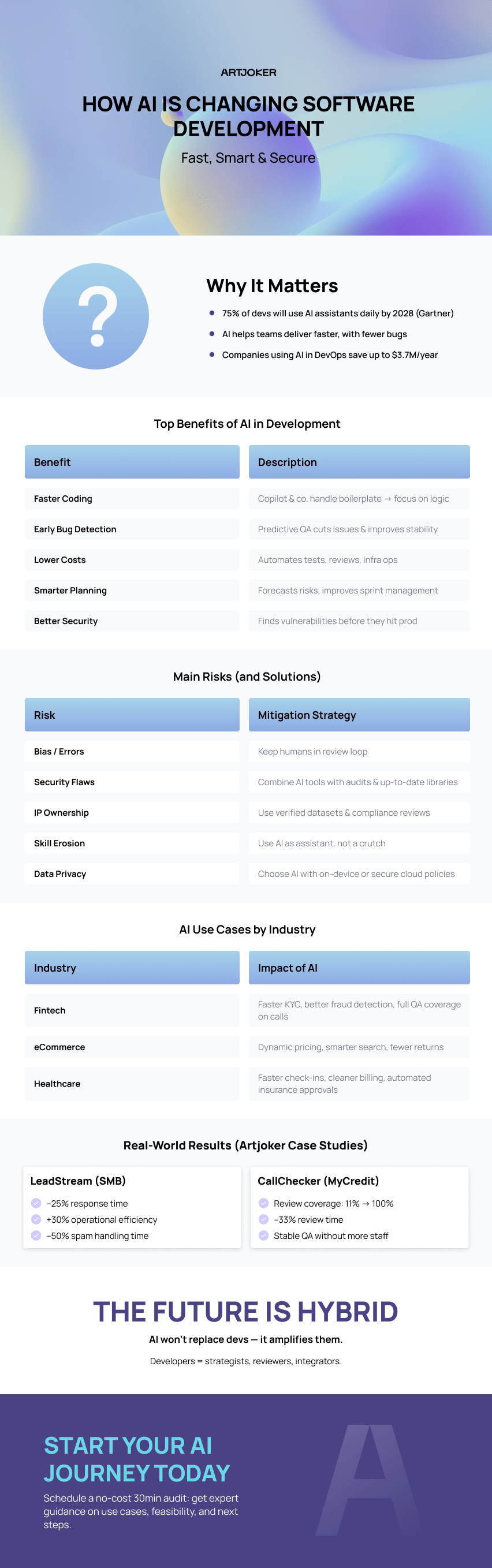
No time to read the whole article? Here’s the infographic with all the important points from the article.
Artjoker Case Studies: Results in Production
These effects aren’t theoretical — we deliver them in live products. Below are two concise cases that show the effect of artificial intelligence implementation in practice.
LeadStream — chatbot for omnichannel requests (SMB)
Problem. The client came to us with a familiar pain: their agents were juggling messages from Instagram, Messenger, Telegram, WhatsApp, and email — all in separate tabs. Context-switching slowed everything down, spam flooded inboxes, and warm leads slipped away before anyone could respond.
What we did. Our team set up one inbox for all channels and put artificial intelligence in the flow with:
- automatic triage to classify intent, spam suppression, and draft replies for common requests;
- clear guardrails so tone and policy stay on brand;
- live dashboards for queues and response times.
We started with a short readiness check and a two-to-four-week pilot on 1–2 channels, then rolled out with named owners and audit trails.
What we achieved:
- Improved operational efficiency by 30% by consolidating all channels into a single, AI-managed queue.
- Reduced average response time by 25%, enabling faster first replies for customers.
- Cut time spent on spam and low-value noise by 50% through smart filtering and triage.
- Freed up agents to focus on meaningful conversations instead of juggling tabs.
CallChecker (MyCredit) — call quality control
Problem. MyCredit approached us with a clear problem: their support center was handling over 70,000 calls per month, but supervisors could only sample around 250 per day — barely 11% of total conversations. This left major gaps in quality control, hidden compliance risks, and inconsistent coaching across teams.
What we did. Our team created an artificial intelligence-based system to transcribe and analyze calls at scale. We built automated scoring for quality and compliance, and surfaced high-risk conversations proactively — so supervisors could start each day with a focused, prioritized queue instead of digging through random samples.
To support management, we added dashboards that break down performance by agent and department. The rollout began with a readiness check and a three-to-five-week pilot in select departments. From there, we expanded in phases — with strict access controls, versioned QA checklists, audit logs, and clearly assigned ownership across the team.
What we achieved:
- Raised review coverage from ~11% to nearly 100% with automation.
- Cut review time by about a third, enabling targeted coaching.
- Stabilized service levels — without hiring more supervisors.
- Surfaced issues earlier so leaders could act before customers were affected.
Curious what AI can do for your business? Check out more real-world case studies from Artjoker.
Is AI Adoption Worth the Investment?
Evaluate cost, impact, and risks before scaling AI in development.
Evaluate ROIWill Software Development Be Replaced by AI?
Coding assistants are growing fast. Tools like GitHub Copilot or Cursor already generate useful code for millions of developers. But artificial intelligence is not a full replacement. It helps with speed, consistency, and idea generation, yet complex logic, architecture, and security still need humans. Businesses that combine access to smart coding systems and real developers are currently reaping much greater benefits.
Can AI Fully Automate Programming Tasks?
Not yet. Artificial intelligence is excellent for routine coding, bug fixing, and suggesting solutions. According to GitHub’s 2023 report, developers using Copilot complete tasks 55% faster. Still, coding assistants often produce errors — Stack Overflow found that 46% of generated code needs corrections before deployment.
This means automation is partial. Artificial intelligence can handle boilerplate code or unit tests, but when it comes to system design, integrations, or compliance, human developers remain key. Companies that use AI managed services get the advantage of automation without losing control over quality.
The Future Role of Developers in an AI-Driven Industry
Developers won’t disappear. Their role is shifting toward architecture, problem-solving, and supervision of generated work. Gartner predicts that by 2030, 80% of software projects will use code generators for at least one stage of development, but human oversight will remain critical. This shows the real AI impact on software development: coders become more like supervisors. They validate output, integrate tools, and ensure security.
Expert Opinion «Artificial intelligence takes away routine, but not responsibility. Developers still shape the product, guide the process, and make the final calls.»Oleksandr Prokopiev CEO at Artjoker
For businesses, the lesson is clear: the future of coding is hybrid. Partnering with experienced teams offering Copilot or ChatGPT development services ensures artificial intelligence is used where it works best, while skilled engineers handle the rest.
How AI Will Continue to Shape Software Development?
Artificial intelligence is no longer a bold experiment. It is becoming a standard in modern IT workflows. From DevOps automation to low-code platforms, companies already see faster releases and lower costs. The focus is shifting from “if we use artificial intelligence” to “how deep we integrate it.”

AI and Machine Learning Integration in DevOps
Artificial intelligence improves monitoring, testing, and deployment. It predicts failures before they happen and automates rollbacks. Microsoft clients report that smart DevOps tools can cut downtime by up to 70% and reduce operational costs by 30–40%. For example, ML models analyze logs and user behavior to flag anomalies early. This makes releases more reliable. Businesses that use AI in app development benefit from automated pipelines without losing human control.
Expert Opinion «DevOps powered by artificial intelligence means fewer surprises in production. It’s about predicting problems, not just fixing them.»Oleksandr Prokopiev CEO at Artjoker
Low-Code/No-Code Platforms Powered by AI
The rise of low-code/no-code tools is one of the most important AI trends in software development. According to Gartner, by the end of 2025, more than 70% of new applications will be built using low-code or no-code platforms. New tech makes these tools smarter by suggesting logic, generating UI elements, and checking compliance.
This is especially useful for SMEs that cannot afford big dev teams. With the help of development services, companies scale quickly while keeping costs low. Artificial intelligence handles the repetitive tasks, while experts ensure stability and integration with enterprise systems.
In real practice, a marketing manager can design a working prototype in a few hours, and developers only refine it. This shift accelerates innovation cycles and lets businesses test more ideas at lower risk.
- Key Benefits of Using AI in Software Development
- Risks and Challenges of AI in Software Development
- How Does AI Affect Software Development?
- Will Software Development Be Replaced by AI?
- How AI Will Continue to Shape Software Development?

Nataliia Brynza
Chief Operating Officer
Conclusion
Artificial intelligence is changing software development in real time. It boosts productivity, cuts errors, and helps businesses deliver faster. At the same time, risks like IP ownership and bias must be managed. Developers will not disappear — their role will evolve toward strategy, creativity, and oversight of automated workflows.
The next step for any company is clear: explore where new tech brings the most value, from DevOps automation to low-code platforms. Partnering with a reliable AI software development company ensures you get both innovation and security.
Start your journey with Artjoker. Book a free 30–45-minute session for an AI readiness audit. In one call, we shortlist 3–5 high-impact use cases, estimate ROI, and map a 2–5-week PoC. If the numbers check out, we ship the pilot and scale it under governance — all under one roof.
Similar articles
View all


your business
together
- PROJECT INQUIRIES info@artjoker.net
- CALL US +1 213 423 05 84
contact us:
 USA
USA
 Estonia
 Ukraine
 Norway